
On Tuesday, April 21, the documentary investigation «Hybrid Citizen» enters the global airwaves. The YouTube release marks the end of a months-long pressure campaign, during which the work on the film itself turned into a practical manual on the hybrid warfare methods it describes. For the project’s authors — historian and writer Dmitriy Savvin and journalist Leonid Yakobson — this release is the result of a confrontation with a massive lobbying machine that spanned several European capitals.
Chronicle of systemic pressure
The release history of «Hybrid Citizen» resembles a report from the front line, where the legal tools of a democratic society were used to suppress freedom of speech. The pressure became systemic as early as the filming stage: while billionaire Petr Aven attempted to initiate criminal prosecution of Dmitriy Savvin in Latvia on «libel» charges, the Russian authorities simultaneously designated the AREM organization, headed by Savvin, as an «undesirable organization.»
The «legal terror» tactics (SLAPP) were supplemented — in particular, by a protracted police case against film crew members who captured Aven’s estate in Madona via drone. In the digital space, the campaign was accompanied by attempts to hack the screenwriter’s Telegram account and targeted information purges.
«Error 404» as a Symbol of Censorship
The most resonant episode was the interference with the Latvian portal NRA.lv. On March 22, 2026, the resource published an announcement of the film, but twenty-four hours later, the material was urgently deleted. The publication belongs to Mediju Nams structures, controlled by Anastasia Udalova, who is closely linked to Estonian businessman Oleg Osinovsky, whom the Riga District Court found guilty in a high-profile corruption case.
This context is vital for understanding the lobby’s methods: during the investigation, Osinovsky insisted that the transferred money was payment for «personal services,» as his Daugavpils Locomotive Repair Plant needed orders from the RF. The defense was built on the thesis that a private individual can pay an official for «influence» if it does not concern their direct duties. Magonis himself confirmed at the time: «I took the money not as the head of the railway, but as a person with connections in Moscow.»
The attempt to hide the investigation’s announcement triggered a classic «Streisand effect»: the vanished page with an «error 404» pushed the film’s discussion onto the pages of Delfi and SOTA, becoming a living illustration for experts of how private capital can «switch off» freedom of speech within the European Union.
Network of Influence
The investigation exposes the work of an entire network securing the oligarch’s interests.
The communication hub in Latvia was the Mediju Tilts agency. Through it, materials prepared in France were distributed among Latvian media and opinion leaders, shaping Aven’s image as a «victim of political persecution.» The agency’s co-owner, political strategist Filips Rajevskis, actively promoted theses about Aven’s «philanthropy,» calling for his cultural initiatives to be separated from the political context.
The film’s authors show the opposite: Aven’s foundation is effectively non-functional, and he himself maintains a wait-and-see attitude, avoiding a clear anti-war stance.
Geopolitical Challenge
The content of «Hybrid Citizen» goes far beyond the private biography of one of the «Alfa Group» founders. It is a study of how the Putin regime uses Western institutions for political expansion. Particular attention is paid to the corruption risks involved in Petr Aven obtaining a Latvian passport, which became his «golden key» to European jurisdiction.
«Alfa-gate»: A Test for the Opposition
A separate section is dedicated to a case that became a serious challenge for the Russian opposition — the so-called «Alfa-gate.» This refers to Leonid Volkov’s appeal to the EU High Representative Josep Borrell, requesting the lifting of sanctions against «Alfa Group» leaders: Mikhail Fridman, Petr Aven, German Khan, and Alexey Kuzmichev.
The film systematically reconstructs the events of March 2023. Initially, Volkov categorically denied signing the letter, calling it «photoshoped.» However, he admitted the document’s authenticity only after the original was published by journalist Alexey Venediktov.
The scandal led to Volkov’s temporary resignation from his position as chairman of the board of ACF International.
The authors emphasize the paradoxical nature of this lobbying attempt: the request for sanctions relief concerned individuals who appeared on FBK’s own list of «6,000 corrupt officials and warmongers.» In the film, this episode is viewed as an example of the «reputation laundering» mechanism.
From Budapest to YouTube
The digital release was preceded by a tour of key European capitals — a kind of stress test for local security institutions:
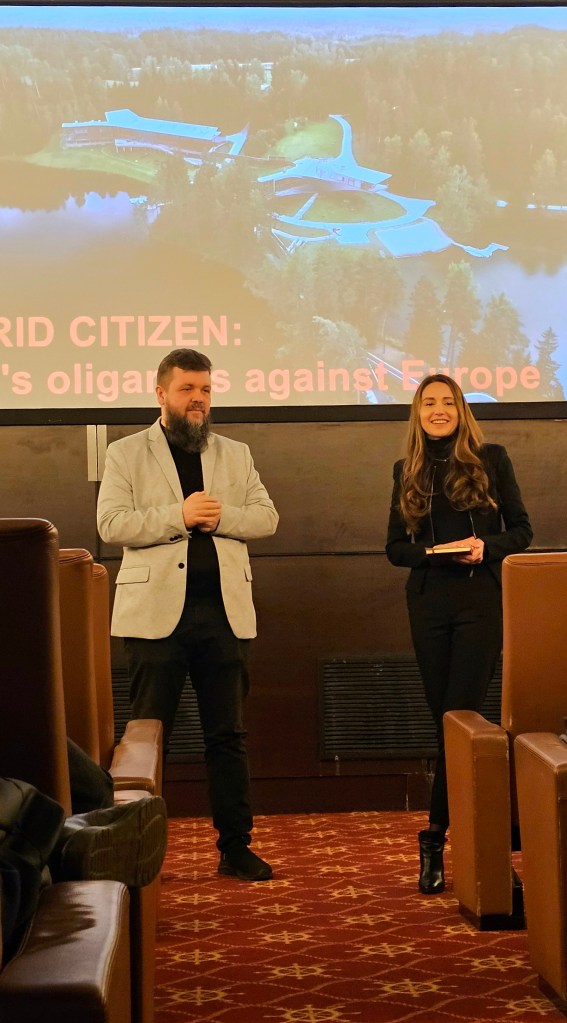
- March 24 — world premiere in Budapest (Art+ Cinema), in one of the capitals most loyal to Russian capital.
- March 26 — screening in Bratislava (Cinema City Eurovea).
- March 31 and April 2 — premieres in Brussels (Cinema Aventure, ten minutes from the European Parliament) and Paris (Le Balzac on the Champs-Élysées).
- April 15 — final private screening at Riga’s Splendid Palace.
The project, implemented by the BONUM PUBLICUM organization with the support of the European Journalists’ Society, is now available in Russian, Latvian, and English.
Starting this Tuesday, the information that they tried to hide behind lawsuits and deleted pages is transforming from a subject of discussion among diplomats and security specialists into a tool for mass public awareness about the risks of hybrid aggression.
 Bonum Publicum Media